Best Serum for Dry Tight Skin
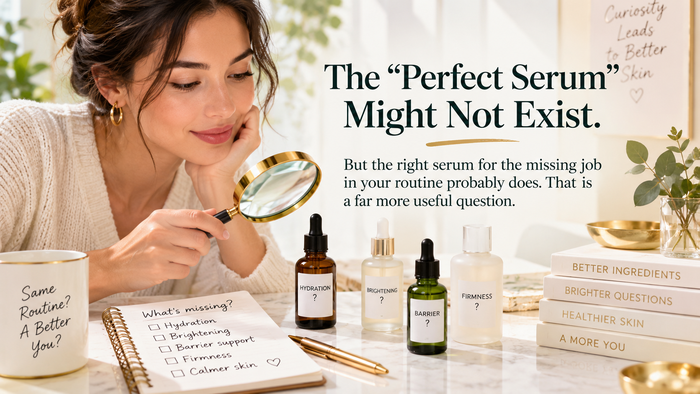
Dry tight skin usually needs comfort plus moisture support, not just a watery serum slapped under a routine that leaks.
The short answer
The best serum for dry tight skin is usually a hydration and barrier-comfort serum used early in the routine and sealed with moisturizer.
The best serum for dry tight skin is usually a hydration and barrier-comfort serum used early in the routine and sealed with moisturizer. Tightness is the key clue. It often means the skin does not just need water-feel hydration; it also needs the routine to reduce moisture loss and surface discomfort.
What dry tight skin means
Dry tight skin feels stretched, uncomfortable, or papery after cleansing, showering, cold weather, air-conditioning, or too many active products.
Dry tight skin feels stretched, uncomfortable, or papery after cleansing, showering, cold weather, air-conditioning, or too many active products. It may not always look flaky. Sometimes the problem is sensation first and appearance second. That is why choosing only by visible dullness can send you toward the wrong serum.
Hydration is only half the answer
A lightweight hydration serum can help, but tight skin often needs something over it.
A lightweight hydration serum can help, but tight skin often needs something over it. Hyaluronic acid, PDRN + HA style hydration support, or gentle peptide support can sit early in the routine. Moisturizer then helps seal the comfort. Hydration without sealing can be like filling a bucket with a hole in it, which humans do surprisingly often with prettier packaging.
Barrier comfort matters
If tightness comes with stinging, redness, roughness, or sudden sensitivity, barrier comfort should move up the priority list.
If tightness comes with stinging, redness, roughness, or sudden sensitivity, barrier comfort should move up the priority list. A brightening serum may still be useful later, but the first job is getting the routine calm enough to tolerate treatment products.
Cleansing mistakes that worsen tightness
Over-cleansing, hot water, foaming cleansers that leave the skin squeaky, and morning cleansing when the skin only needed a rinse can all make tightness worse.
Over-cleansing, hot water, foaming cleansers that leave the skin squeaky, and morning cleansing when the skin only needed a rinse can all make tightness worse. A serum cannot fully rescue a cleanser that keeps stripping comfort every morning. The routine has to stop creating the problem before a serum can help.
Morning routine for dry tight skin
Keep morning simple: rinse or cleanse gently, apply hydration or comfort serum, use moisturizer, then sunscreen.
Keep morning simple: rinse or cleanse gently, apply hydration or comfort serum, use moisturizer, then sunscreen. If makeup is involved, give each layer time to settle. Avoid adding strong vitamin C, exfoliating acids, or heavy renewal products until tightness improves.
Night routine for dry tight skin
Night should focus on comfort.
Night should focus on comfort. Cleanse gently, apply a hydration or comfort serum, then moisturizer. Add renewal only when tightness is controlled. If the skin feels worse the morning after a night active, reduce frequency before blaming every product in the bathroom like a dramatic little tribunal.
When to choose a system
A single hydration serum may work when dryness is the only signal.
A single hydration serum may work when dryness is the only signal. A system becomes more useful when dryness overlaps with dullness, fine-line appearance, and loss of bounce. In that case, order matters: hydration and comfort first, support next, renewal later.
How this differs from dehydrated skin
Dry tight skin is defined by discomfort and moisture loss.
Dry tight skin is defined by discomfort and moisture loss. Dehydrated-feeling skin is often a water-balance signal that can appear even when the skin looks shiny. Dry-by-afternoon skin is time-based. This page focuses on tightness and comfort.
Decision table
| Clue | Likely cause | First fix |
|---|---|---|
| Tight after cleansing | Cleanser too stripping | Gentle cleanse + comfort serum |
| Tight in air-conditioning | Moisture loss | Hydration serum + moisturizer |
| Tight and stinging | Barrier discomfort | Pause strong actives |
| Tight under makeup | Surface dryness | Thin hydration, seal lightly |
| Tight after night actives | Frequency too high | Reduce actives and restore comfort |
When the quiz is the better shortcut
If dryness, dehydration, afternoon tightness, dullness, makeup pilling, and sensitivity overlap, use the quiz to identify the first missing serum role. Otherwise you are just buying tiny bottles and hoping one of them has a personality.
Related dry and hydration guides
Frequently asked questions
Is this medical advice?
No. This is cosmetic skincare education only and does not diagnose, treat, cure, or prevent skin disease.
Should serum go before moisturizer?
Usually yes. Serum normally goes before moisturizer and before sunscreen in the morning.
Can I use more than one serum?
Yes, but introduce one at a time and keep the order clear.
Should dry skin use vitamin C?
It can, but hydration and comfort should usually be stable first.
Should I use sunscreen?
Yes. Sunscreen should be the final skincare step in the morning.
Can dehydration look oily?
Yes. Skin can look shiny while still feeling dehydrated or tight.
How long should I test a hydration serum?
Hydration may feel different quickly, but a stable routine should be watched over several days.
What if every serum stings?
Pause strong actives and focus on gentle cleansing, hydration, and barrier comfort.
Do I need a serum system?
A system helps when several skin roles are missing at once.
Should I take the quiz?
Yes, if you cannot tell whether your first missing role is hydration, brightness, support, comfort, or renewal.
Find your first missing serum role
Use the quiz to decide whether your routine should prioritize hydration, brightness, support, barrier comfort, or renewal.
Start Skin QuizFinal decision guide
Best Serum for Dry Tight Skin should help the reader make a serum decision from a real skin signal, not from a product trend. The useful lens here is dryness and hydration. A good page should explain what the concern usually means in a routine, which serum role fits first, and when buying another product may be premature.
The first decision is whether the skin needs comfort, support, brightness, or night renewal. Comfort usually means hydration and barrier-feel support. Support usually means peptide-style or routine-structure help. Brightness usually belongs where dullness or uneven tone appearance is the main issue. Renewal usually belongs at night, especially when the morning routine is already crowded.
The second decision is whether the current routine is already too complicated. When someone owns several products but cannot explain the job of each one, the problem may not be a missing serum. It may be missing order. Adding another active in that situation can make the routine harder to judge.
The practical approach is to change one role at a time. If tightness is the strongest signal, start with hydration. If dullness is the strongest signal and the skin is comfortable, check a brightness step. If fine-line appearance and firmness look are the main concerns, examine the night routine. If products pill under sunscreen or makeup, fix texture and sequence before adding more.
This page is not medical advice and does not diagnose skin conditions. It is a cosmetic decision guide for choosing a simpler serum role before buying again.
| Decision | What to check |
|---|---|
| Strongest signal | Dryness, dullness, sensitivity, pilling, or visible aging concern. |
| Serum role | Hydrate, support, brighten, or renew at night. |
| Routine fit | Whether the product makes daily use easier or harder. |
| Next action | Use the quiz before buying another bottle. |
Frequently asked questions
What should I compare before choosing a serum?
Compare the main skin signal, the serum role, texture, timing, tolerance, and whether the product repeats something already in the routine.
Is one serum enough?
One serum may be enough for one clear concern. If dryness, dullness, sensitivity, and visible aging concerns overlap, a sequenced routine may be easier.
Should hydration come first?
Hydration should come first when skin feels tight, dry by afternoon, or when makeup and sunscreen sit badly on the skin.
When should brightness come first?
Brightness is usually more relevant when skin feels comfortable but looks dull, uneven, or tired.
When should I avoid adding another active?
Avoid adding another active when skin stings, pills, feels hot, or already has several treatment steps.
Why does order matter?
Order affects comfort, absorption feel, sunscreen finish, and whether the routine is repeatable.
Can sensitive skin use this guidance?
Yes, but sensitive skin should simplify, patch test, and introduce one product at a time.
How do I know if my routine is overloaded?
If you cannot explain what each serum does, or if products pill and skin feels reactive, the routine may be overloaded.
What is the simplest decision rule?
Choose the next serum by role: hydrate, support, brighten, or renew at night.
What should I do next?
Use the quiz to match the strongest skin signal to a clearer AM/PM sequence before buying another product.